The role of parliamentary diplomacy in bringing high-level agreements closer to people's lives in Central Asia
 publisher
ARTICLE
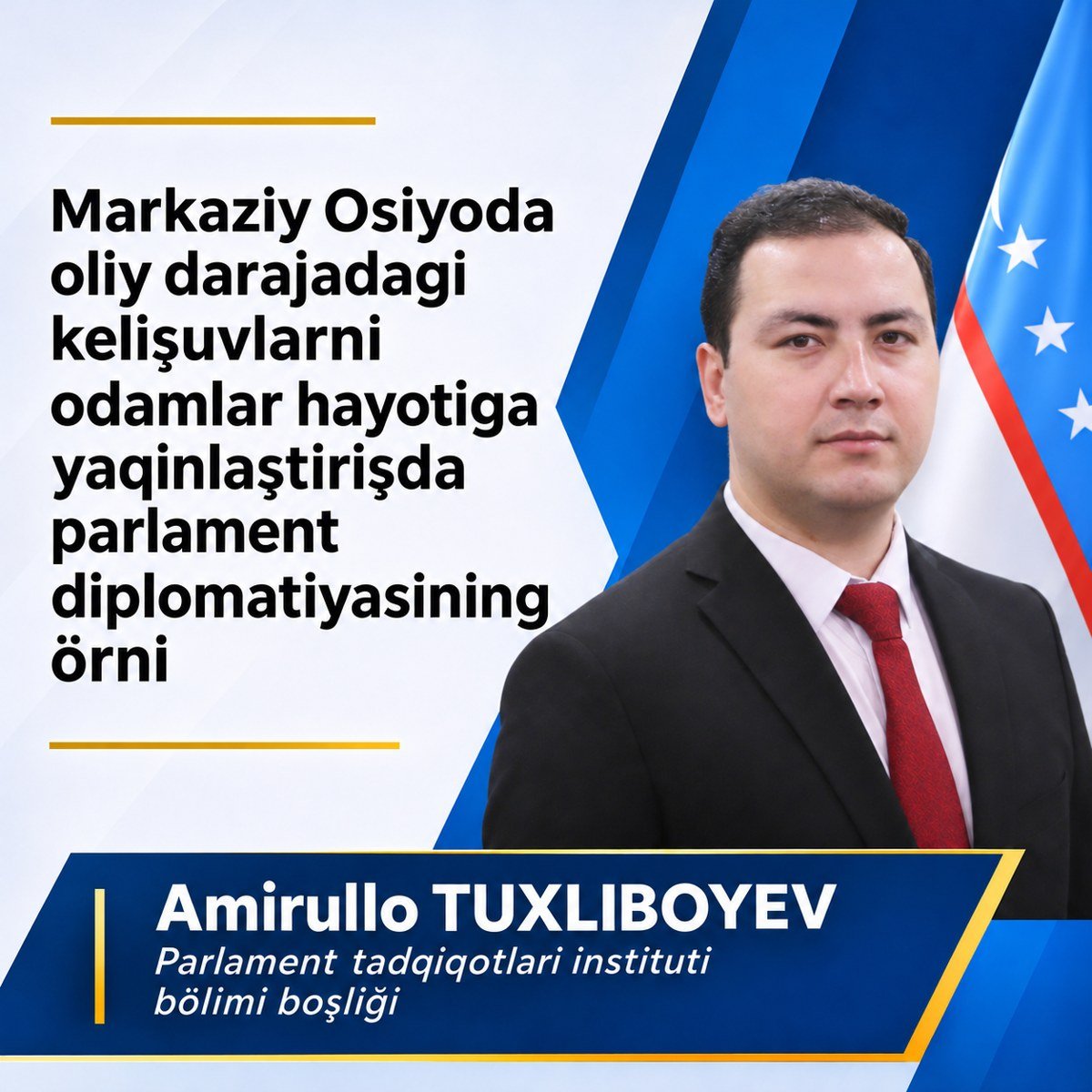
Amirullo TUXLIBOYEV
Head of the Department of the Parliamentary Research Institute
Summits are concluded, statements are accepted, documents are signed. But for a driver waiting in line at a border post, an entrepreneur who wants to export products to the market of a neighboring country, or a young professional who wants his diploma to be recognized on the other side, the main question arises the next day. So what will change in my life?
The true value of regional cooperation is measured by the answer to this question. Between a high-level deal and ordinary human life are legislative, budgetary and oversight steps, all of which pass through parliament. Therefore, today's task of parliamentary diplomacy is to bring the interstate dialogue from protocol meetings to the solution of concrete problems.
Ten years of regional cooperation
Today's regional agenda is the result of reforms in foreign policy in recent years. The consultative meetings of the heads of the regional states began with the initiative of President Shavkat Mirziyoyev at the international conference held in Samarkand under the auspices of the UN in November 2017. The first meeting took place on March 15, 2018 in Astana. Since then, this format has become a permanent forum where the countries of the region discuss the problems of the region.
The results of this policy can be seen in the numbers. In 2017-2025, the volume of trade with Central Asian countries increased 3.1 times and reached 8.3 billion dollars. The number of enterprises with investment from regional countries increased more than seven times and reached 2,384 as of June 2026. In 2017, 2.1 million dollars were invested from the countries of the region, and in 2025, this figure was 1.3 billion dollars. On August 28, at the solemn ceremony dedicated to the 35th anniversary of the state's independence, the President noted that historical progress has been made in expanding friendly relations, strategic partnership and friendly relations in Central Asia.
The regional agenda is in sync with Uzbekistan's own development goals. At that ceremony, the head of our state called the next decade the period of national growth and announced seven national programs. The seventh of them is aimed at increasing the reputation of Uzbekistan as a land of peace and friendship, a tolerant country in every way. The fifth direction of the "Uzbekistan-2030" strategy, updated by the Decree of February 16, 2026, is dedicated to the consistent continuation of the policy based on the principle of "A safe and peace-loving state". The updated strategy envisages a 1.5-fold increase in trade turnover with neighboring countries over the next five years.
The parliamentary direction of cooperation was also formed. On February 10, 2023, the first Inter-Parliamentary Forum of Central Asian countries was held in Turkestan, Kazakhstan, and the Turkestan Declaration was adopted. At the seventh Consultative meeting held in Tashkent on November 16, 2025, Azerbaijan was unanimously supported to join this format as a full participant. At that time, the President proposed to turn the Consultative meetings into a strategic platform called "Central Asian Community" and to adopt a regional trade and economic cooperation program until 2035.
Initiatives promoted in Awaza
On October 8, 2026, the eighth consultative meeting of the heads of state of Central Asia and Azerbaijan was held in the "Avaza" national tourist zone of Turkmenistan. Azerbaijan took part in this meeting as a full participant for the first time and assumed the chairmanship of the Consultative meetings. In the end, the Joint Statement was adopted, and a number of multilateral documents were signed.
At the summit, the President put forward proposals for the consistent elimination of trade barriers, expansion of industrial cooperation, coordination of large transport projects, implementation of joint projects in the fields of energy, water and ecology. The formula "Six economies - one product" presented by our head of state is the core of these initiatives. When businesses from several countries create the final product together, stronger economic ties are created than simple trade.
For this purpose, in 2027, it was proposed to hold a business forum of Central Asia and Azerbaijan in ancient Khiva and to create a platform for financial and technical monitoring of joint investment projects. The issue of the platform will be considered by the Council of Ministers of Trade and Investment at its next meeting in Ashgabat. The comprehensive regional trade and economic cooperation program until 2035, proposed in Tashkent, should become a working tool, as noted by the President.
The head of state also proposed to improve the normative legal framework regulating the activity of consultative meetings and noted that the procedures for concluding the agreement on friendship, good neighborliness and cooperation have been completed. According to our Constitution, ratification of international agreements is the competence of the chambers of the Oliy Majlis.
None of the initiatives put forward in Awaza will be realized by themselves. For joint production, it is necessary to match technical requirements, simplify customs procedures, and protect investor rights equally on both sides of the border. All this is a matter of legislation.
The role of parliaments in the implementation of agreements
The strength of parliamentary diplomacy lies in its representative nature. MPs and senators are in constant communication with voters, businessmen, and the neighborhood and are the first to hear about problems that are an obstacle to cooperation. Regular contact with a colleague in a neighboring country helps to understand how the issue looks from the other side. A procedure that is considered a simple administrative requirement on one side can become a serious obstacle for a citizen or an enterprise on the other side.
Let's imagine that a company that transports products between two countries has to issue a document with the same content separately on both sides of the border. Such an issue is not on the agenda of the summit, but it determines the "price" of cooperation for the enterprise. The situation will become clearer if the relevant committees of the two parliaments study the problem with the participation of businessmen, customs officials and experts. If the obstacle arises from a legal norm, a proposal to change the norm is prepared. In the case of law enforcement, the information of the responsible office is heard and corrective measures are determined.
Article 93 of our Constitution empowers the Chambers of the Oliy Majlis to adopt laws, ratify international agreements, determine the main directions of domestic and foreign policy, and adopt the State budget. Therefore, the parliament is directly involved in determining the foreign policy and in its implementation. It is appropriate to look at every task in Avaza documents from this point of view. Which issue requires improvement of the legislation, which requires a budget discussion, and which requires hearing the information of the responsible agencies? The impact of new initiatives on citizens, businesses and government spending should also be assessed in advance.
Proposals announced on Monday
On October 29, 2026, the fourth inter-parliamentary forum of Central Asian countries was held in Dushanbe on the theme "Unity for peace, security and prosperity in Central Asia" and the Dushanbe Declaration was adopted. At the forum, the Chairman of the Senate of the Oliy Majlis, Tanzila Narbayeva, offered legal assurance and control over the implementation of the agreements reached by the heads of state, and the expansion of cooperation between local councils. At the forum, the issues of reducing trade barriers, developing joint production and transport corridors, rational use of water were also discussed, and a proposal was made to hold a joint parliamentary discussion on "green" changes and legal mechanisms for water saving.
Within the framework of the forum, the meeting of the Chairman of the Senate with the Chairman of the Kurultoi of Kazakhstan's unicameral parliament, Aybek Dadebay, is also noteworthy. It proposed to consider the possibility of creating a joint inter-parliamentary commission, to develop a "road map" for 2027-2028, to revive relations between the committees, and to regularly discuss the implementation of the agreements of the heads of state. Exchange of experience on regulation of artificial intelligence and protection of personal data was also envisaged.
What does foreign experience show?
How to organize such work? Although the experience of inter-parliamentary structures in the world does not provide a ready-made model for this question, it shows tested methods.
Every proposal introduced by deputies in the Northern Council is first sent to the appropriate committee. The committee can request opinions from national agencies, hold hearings with the participation of experts, and, if necessary, create a working group. The committee then submits its recommendation to the Presidium or the session, which forwards it to the governments or the Northern Council of Ministers. Committees also cooperate with relevant committees in national parliaments. The takeaway from this experiment is simple. For a recommendation to be heard, there must be evidence behind it.
Even in Central Asia, for example, before preparing a joint recommendation on the simplification of transport procedures, it is necessary to compare the current rules, calculate costs and hear the opinions of carriers. The recommendation then covers the problem, its cause, and the proposed solution.
The experience of the ASEAN Inter-Parliamentary Assembly (AIPA) answers another question. What will be the future of the decision? Within the framework of the AIPA Caucus, established by the decision of the 28th General Assembly of AIPA in 2007, member parliaments monitor the implementation of resolutions and prepare common initiatives for the harmonization of legislation. According to the AIPA Secretariat, as of July 2026, 85.53 percent of the 273 resolutions adopted in 2017-2026 have been implemented. During the ASEAN summits, dialogue is held between the heads of state and representatives of AIPA.
A clear plan and open report
It is possible to choose from foreign experience suitable for Central Asian conditions. In our view, two practical steps will be effective in this.
First, it is useful to make it a regular practice to develop an agreed work plan for high-level agreements between the relevant parliamentary committees. It should indicate the topic of each discussion, the expected result and the deadline for returning to the issue. The "road map" proposed to be developed between the parliaments of Uzbekistan and Kazakhstan for 2027-2028 is one of the practical examples of such a plan.
Second, if each joint activity begins with information on what has been done on previous recommendations, the gap between promise and result is immediately apparent. If the implementation of recommendations is measured as a percentage, as in AIPA's experience, the public can see this difference.
On the eve of the next consultation meetings, the parliamentary committees can prepare generalized proposals on the identified legal obstacles and their solutions.
❝ Naturally, each country considers such proposals within the framework of its constitutional powers and national procedures. ❞
Amirullo TUXLIBOYEV,
Head of the Department of the Parliamentary Research Institute