The guarantee of water-saving technologies is protected by law
COMMENTARY
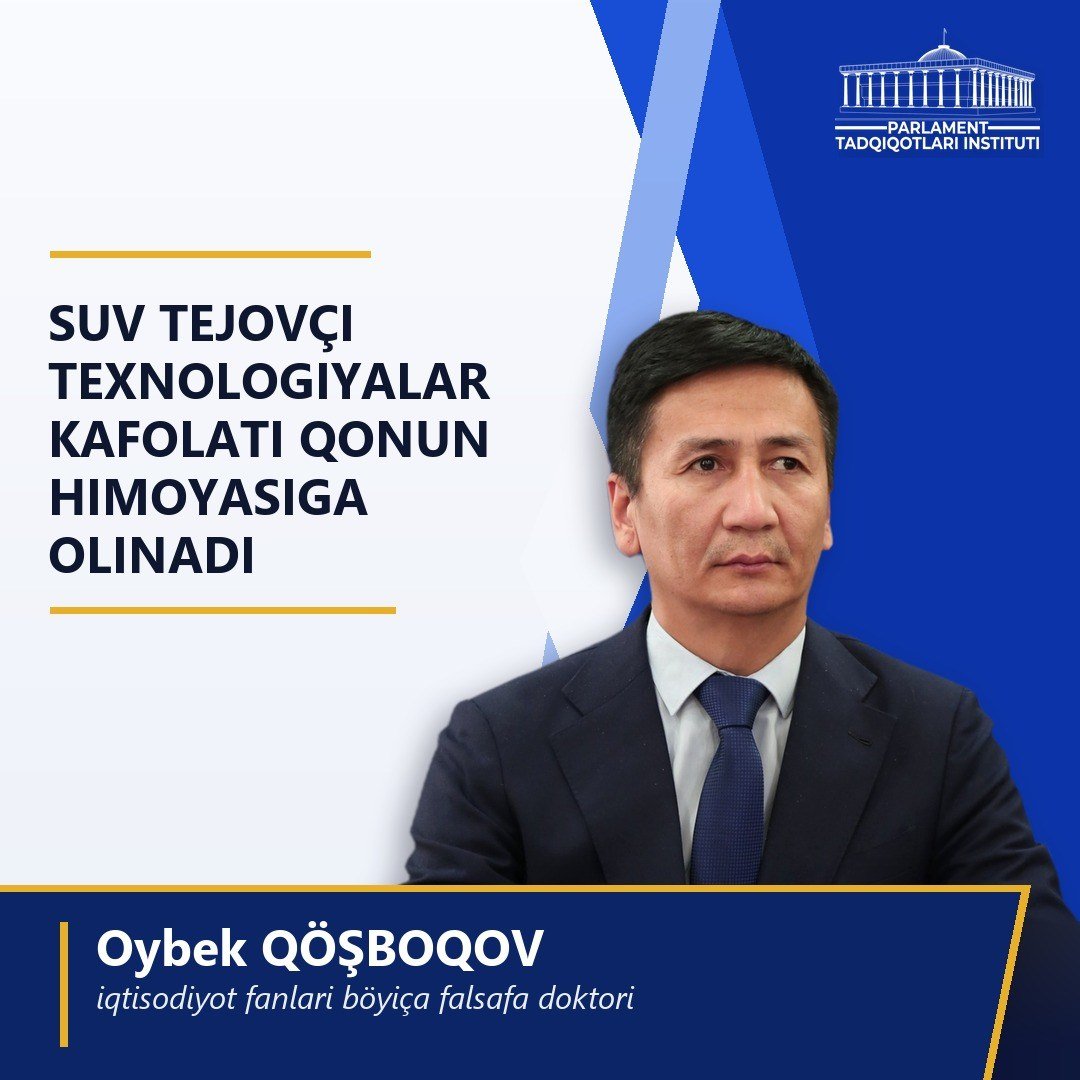
Oybek QOSHBOQOV
Head of the Department of the Parliamentary Research Institute under the Legislative Chamber of the Oliy Majlis, Doctor of Philosophy in Economics
According to Article 68 of our Constitution, land, underground resources, water, flora and fauna and other natural resources are national wealth, they must be used wisely and are under state protection. In today's conditions, where the demand for water resources is increasing every year, this constitutional requirement is directly connected with the task of saving every drop of water in agriculture.
On November 11 of this year, the Cabinet of Ministers submitted to the Legislative Chamber of the Oliy Majlis a draft law on amendments and additions to Article 9 of the Law of the Republic of Uzbekistan "On State Duty". The draft was discussed in the first reading in the Legislative Chamber. Although its size is compact, this document creates an important legal mechanism for protecting the rights of agricultural producers who implement water-saving technologies.
The reform was initiated by the head of state
The widespread introduction of water-saving technologies has become a consistent state policy since 2017 at the initiative of President Shavkat Mirziyoyev. According to the information presented to the head of state on February 3 of this year, these technologies were introduced on a total of 19,000 hectares before 2017. Today, their coverage has reached 2.6 million hectares, that is, 60% of irrigated land, 2.5 billion cubic meters of water are saved annually.
According to the reference attached to the draft law, in 2017-2025, drip irrigation technologies were introduced on 664.3 thousand hectares, sprinkler irrigation on 122.6 thousand hectares, discrete irrigation technologies were introduced on 73 thousand hectares, 1.6 million hectares were leveled with the help of a laser. A total of 9 trillion soums, including 4 trillion soums of concessional loans, were allocated for this purpose. This year alone, 134,700 hectares were drip-fed, 26,700 hectares were irrigated, 104,000 hectares were equipped with discrete irrigation technologies, and 303,000 hectares of land were laser leveled at the expense of Agrobank's 1.4 trillion soum preferential loan.
The decision of the head of our state dated February 5, 2026 "On additional measures to increase the efficiency of water resources use" No. PQ-47 started a new stage in this direction. In the decision, in 2026-2028, the area where water-saving technologies have been introduced is set to reach 3.5 million hectares, thereby saving 5 billion cubic meters of water annually. This year, commercial banks will allocate 2.6 trillion soums of loans for these purposes. From October 1, such technologies are installed in a mandatory manner based on the approved minimum requirements and standards, and the procedure for the production of pump and filter devices with a special digital QR-code was introduced.
One of the important innovations of the decision concerns the responsibility of contractors. Contracting organizations that have built water-saving technologies are required to provide at least a two-year warranty for each project and to provide service for five years. The supervision of the implementation of this requirement was assigned to the inspection of the safety of water management facilities and control of water use. Sub-paragraph "b" of the 14th paragraph of the decision gives the task of amending the law to exempt this inspection from the state duty when it appeals to the court in the interest of farmers. The project under discussion was developed as a fulfillment of this task.
Where was the problem?
As the range of technologies expanded, problems related to the quality of their installation began to appear. In the explanatory letter of the draft law, it is noted that some contractors did not provide a guarantee for the equipment and made deficiencies in the provision of service. As a result, some farmers did not use the introduced systems during the irrigation season.
Studies have shown the scale of the problem. 917.7 billion soums of concessional loans were allocated under the contracts concluded between 1,020 farms and 167 contracting enterprises. It was found that 560.9 billion soums were spent without purpose, that is, the technology was not introduced at all. This means about 61% of the allocated funds. According to official data, the contractors who built the system on the area of more than 3,848 hectares of 309 agricultural producers in 2024-2026 did not provide guarantees and did not provide service.
In this case, the farmer can claim his fee through the court. However, a state duty is paid in the amount of 10 times the amount of the basic calculation for a non-property claim to the economic court. If we take into account that the base calculation amount from September 1 is set at 440 thousand soums, this means 4.4 million soums. This includes the costs of technical expertise and legal assistance. This is a significant obstacle for a farmer who is burdened with credit and unable to use the system. It should not be forgotten that proving a defect in the irrigation system requires special technical knowledge.
What does the project mean?
With the project, the first part of Article 9 of the Law is supplemented with a new paragraph 7¹. According to it, the inspection of the safety of water facilities and water use control and its regional departments are exempted from paying the state tax when they file a claim in the economic courts in the interest of agricultural producers in connection with the non-fulfillment of contractual obligations related to the installation of water-saving irrigation technologies, guaranteeing their quality and providing service by local and foreign contracting organizations.
The scope of the norm is clearly defined. Freedom is limited to cases of non-fulfillment of contractual obligations regarding technology installation, warranty and service. The draft also amends the second part of Article 9. If the claim is rejected in whole or in part, the state duty will be collected from the inspection in proportion to the amount of the claim rejected. This rule encourages the inspectorate to thoroughly substantiate each claim and prevents unfounded claims. The law shall enter into force from the date of its official announcement.
How it was yesterday and how it will be now
Until now, when a dispute arose with a contractor, the farmer fought against him alone. He had to pay the state tax at his own expense, order an examination to prove the defect, and oppose the contracting organization with qualified lawyers in the court process. In such circumstances, some farmers could refuse to go to court and be left with a dysfunctional system and a loan that must be repaid.
After the adoption of the law, the interest of the farmer will be protected by a state body with technical knowledge and authority. The inspection monitors the fulfillment of warranty and service obligations, documents the violation and, if necessary, applies to the court without state duty. For contractors, this means that the warranty obligation is actually enforced. Contractual discipline will be strengthened, preferential loan funds will be targeted, and implemented systems will work in the field.
This approach is also consistent with current legislation. According to Article 9 of the Law "On State Duty", the Farmers' Council of Uzbekistan and its regional councils are exempted from state duty in economic courts in cases filed in the interests of farmers, peasant farms and landowners. The new norm complements this protection with a specialized state body with technical control authority in the field of water-saving technologies.
In the parliamentary debate
The project was introduced to the parliament with full agreement. It was agreed with 21 ministries and agencies, including the Ministry of Economy and Finance, the Ministry of Agriculture, the Representative for the Protection of the Rights and Legal Interests of Business Entities under the President of the Republic of Uzbekistan, the Council of Farmers of Uzbekistan, the Chamber of Commerce and Industry and the Supreme Court, and a positive conclusion was received from the Ministry of Justice. Factors leading to corruption are not identified in the project.
Water management issues are constantly under the control of the parliament. The Minister of Water Management answered the questions of the deputies at the "Government Hour" held in the Legislative Chamber in November. In our opinion, it is appropriate to pay attention to several practical aspects in preparing the project for further studies. The procedure for accepting and considering the application of a farmer by the inspection and the terms should be clearly defined in the legal document, and a cooperation mechanism should be developed with the Council of Farmers of Uzbekistan. It is also necessary to consider the possibility of using QR-code and data from satellite tracking systems as evidence in court.
Foreign experience
Exemption of public bodies from court costs is used in many countries. According to Article 2 of the German Law on Court Costs, the Federation, federal states and state institutions managed by their budgets are exempted from paying court costs in ordinary courts and in cases in financial and social courts. In Spain, according to Article 4 of Law No. 10/2012 of November 20, 2012, state administration, autonomous communities, local authorities and state bodies subordinate to them are exempt from court fees. The confederations of river basins, which manage water resources in the country, are among such state bodies.
In these countries, freedom is granted depending on the status of the state body. The path chosen in Uzbekistan is very purposeful. The inspection is exempted from state duty only in the interest of farmers and for claims made in connection with clearly defined contractual obligations. A charge for a denied claim will retain responsibility for availing this benefit.
If the bill is passed, several important results will be achieved. The farmer's right to appeal to the court will be freed from financial obstacles, the responsibility of contractors for warranty and service obligations will increase, and the state and credit funds directed to water-saving technologies will be protected.
Most importantly, this change will become a legal guarantee of the goals set in the PQ-47 decision, that is, the introduction of water-saving technologies on 3.5 million hectares by 2028 and the task of saving 5 billion cubic meters of water annually. If each installed system works, the saved water, farmer's labor, and state funds will bear fruit.
❝ The requirement to protect water as a national resource in our constitution is thus strengthened by a clear legal mechanism. ❞
Oybek QOSHBOQOV,
Head of the Department of the Parliamentary Research Institute under the Legislative Chamber of the Oliy Majlis, Doctor of Philosophy in Economics